


Ahmed Boulakhras
https://urn.fi/urn:nbn:fi-fe20260907123276

With the improvements in photogrammetry, higher quality models can be captured by just using a smart phone.
The idea emerged from the need to build a 3D model of the Centria Campus as the model did not exist yet. Using traditional modeling techniques would have been one of the solutions, but we wanted our approach to be broader in scope. With the solution developed, we can utilize it in other projects as well. It can be used to create digital twins, which can be utilized in many different fields.
Importance and usefulness
Image to 3D reconstruction is increasingly proving to be useful in real life applications. It allows accurate and photorealistic digital representations using accessible format: simple images. It also provides crucial spatial data (object measurements, depth calculation, Terrain elevation, …) useful in analysis and visualization.
In practice, the tech is in-demand across different industries. Among these, we can list autonomous navigation, architecture & real estate, VFX & game design and e-commerce.
Historical context and evolution
The transformation from 2D media assets to 3D models became one of the most advanced and thrilling fields in computer vision. It represents the culmination of years of research across graphics and machine learning algorithms.
Historically, it all started with photogrammetry in the early 20th century, experts used a layer of stereoscopic photographs to measure distance and estimate the depth of objects manually. This technique is based on the principle that depth can be deduced from multiple images taken from different viewpoints. The evolution of processing power in the hardware industry allowed the same principle to be digitized and automated through algorithms.
Fast forward to 2010, software like VisualSFM and eventually COLMAP surfaced and it also became the standard for academic researchers and professional industrials. COLMAP being the go-to choice thanks to its accuracy and modularity. It offers a suite of integrated tools such as feature extraction (SIFT), automated correspondence matching and bundle adjustment.
The introduction of Neural Radiance Fields (NeRF) in 2020 was an important checkpoint in the photogrammetry evolution timeline. It marked the blend between deep learning and 3D reconstruction. NeRF algorithms were applied to depth estimation, pose refinement, feature extraction, and bundle adjustment.
Scenes are now represented as continuous volumetric fields learned from video frames, but at the cost of high computational power.
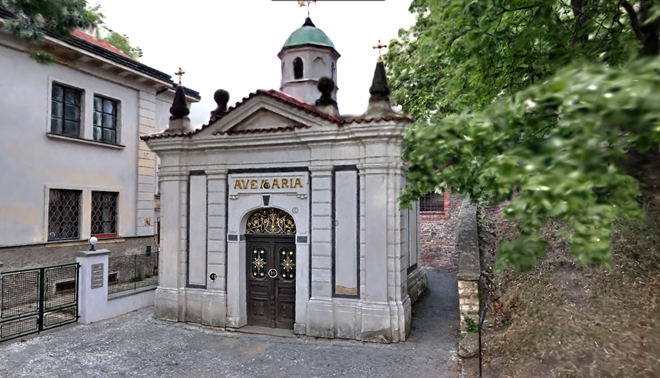
Starting from 2023, Gaussian splatting emerged as an innovative approach that combines the reconstruction of point clouds geometry and the visual fidelity of neural rendering. Gaussian splatting provides a collection of anisotropic 3D gaussians, each with its own position, encoded color and other useful properties.
Current state of the technology
Today, what started as manual photogrammetry evolved into an automatic AI enhanced scene capture capable of producing high fidelity digital 3D reconstructions with precision. Tools such COLMAP can achieve high levels of feature matching and ensure consistent camera pose tracking even with low-quality footage.
Recent progress with deep learning has enabled the improvement of the output quality. Diffusion-based models are being explored to enhance low texture regions and fill in gaps, allowing reconstruction even from incomplete inputs. The introduction of 3D Gaussian splatting has undergone a major shift in the field of neural radiance thanks to its use of anisotropic Gaussians (Kerbl, Bykau & Dally 2023). This allows for real-time visualization, a fast-training period, and control over the rendered geometry by changing properties.
Overall, the current state of image to 3D reconstruction is defined by mature and battle tested pipelines. It starts with tools like SfM and Multi-View-Stereo to provide accurate geometry and camera poses, neural radiance fields to refine appearance and fill in gaps in texture, finally, gaussian splat to output an optimized graphical rendering. (Tomasi and Kanade 1992.)
Problem identification
Even though technology has incredibly advanced during the last decade, it remains highly technical and requires powerful hardware. Additionally, the installation of different methods can cause version conflicts and breakdowns. It was also observed that there are no all-in-one solutions out there that groups different methods of processing under one easily accessible and user-friendly platform. Nerfstudio is the closest solution already available, but it remains behind the barriers of high technical knowledge to access it.
It is in this context that Centria3D has been developed. The idea is to create an accessible, scalable, and modular platform that allows any user to upload their footage, process and train it using different methods without acquiring or installing any special hardware or software. But that’s not all! We have also customized an open-source project to meet the needs of the platform and enable the visualization and editing of Gaussian splats.
Solution
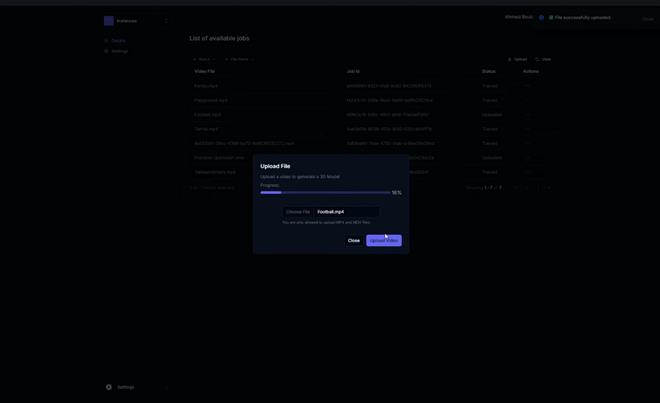
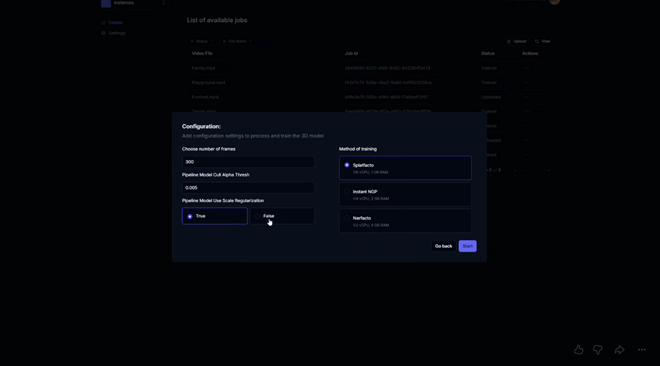
In order to simplify the complex process of photogrammetry pipelines and create accessible user experience, we have developed Centria3D. This is not just an application, it is an all-in-one platform designed to facilitate the creation and manipulation of 3D renderings in the highest and most realistic form, Gaussian Splats. The user can upload any video file recorded using any smartphone’s camera, then, they can choose the type and quality of the 3D rendering they desire and finally, start processing it.
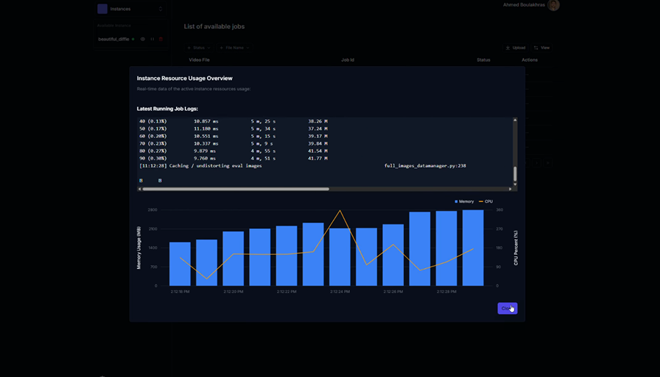
From there, they can monitor the resources usage and the real time progression of each processing job. Finally, when it ends, the user is notified and can export the file to serve locally or open it in the integrated editing software and manipulate the file further.
Technically, the Centria3D platform is engineered in a three-tiered microservice architecture, it is capable of scaling by leveraging GPU processing power during the training step and providing real time performance feedback. The structure separate core concerns: a dedicated backend, a 3D editing interface and a modern user interface management dashboard.
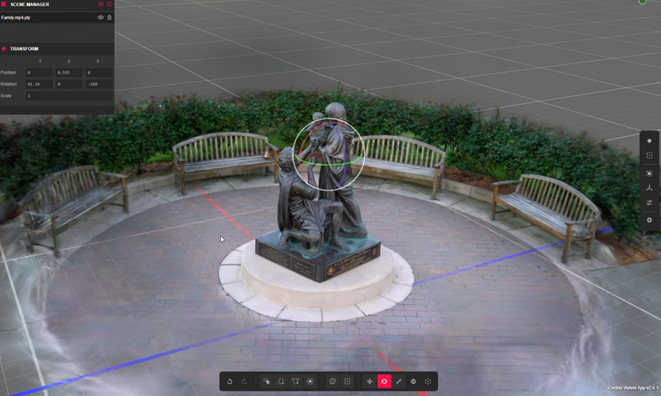
Below are screenshots of the platform in its final version.
The architecture
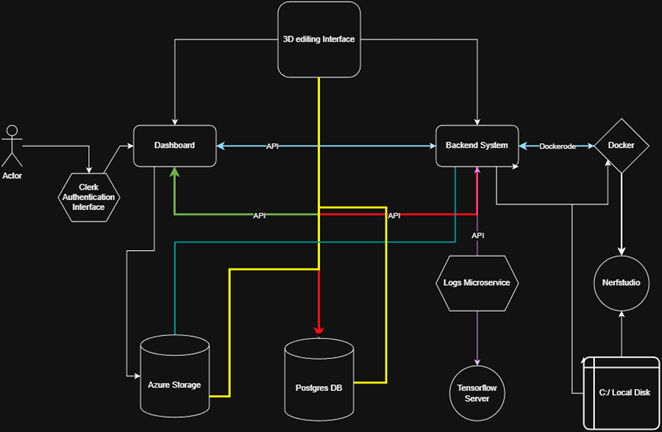
The backend, built using Node.js and Express.js, is the backbone of processing operations of the platform. It connects different microservices and platforms, most importantly, it ensures communication with a Docker instance via its API endpoints. It utilizes Dockerode to manage dedicated processing containers. The backend automatically assigns each user to their dedicated container, which ensures data privacy and scalability when needed. This container will eventually be shut down or deleted to optimize computing resources usage.
The user journey begins with authentication using either their social media account or a working email; they are able then to start a job by uploading the video asset. It will trigger a series of verification, sanitization, and execution operations within the dedicated Docker container. This latter is also connected to Nerfstudio using its open-source image and run command within the container’s command line interface. These commands receive dynamic values that allow customization and extendibility. The user can choose between different processing methods and the detail’s level of the final rendering. Thanks to Nerfstudio’s support, the platform has the technical potential to include different types of processed 3D models that accommodate different use cases. It also provides real time logging and checkpointing using WebSocket streaming to indicate the resources usage and the estimated time to finish the job.
Regarding data storage, all persistent data during the 3D model processing steps are stored in PostgreSQL database which includes user profiles, processing job details. The choice of the database was made to ensure data integrity and consistency. For larger assets such as the video file and the final 3D model, the backend calls Azure blob storage API to synchronically upload the data. It manages the upload and retrieval of data providing time specific shared access signature links to the frontend.
Next piece of the puzzle was the design of user interface. Built with Next.js framework coupled with TypeScript and TailwindCSS for the styling, the frontend provides simple and intuitive user experience for managing data and initiating processing jobs. The frontend communicates with the backend using secure RESTful API calls via Axios. It maintains a separation of concerns from the operational layer. The interface also provides monitoring and telemetry feature connected to the logs microservice and the backend. This ensures a new transparent and informative experience for the user, especially that processing jobs can often take up a significant number of resources and time.
Finally, we have added and adapted the open-source project called SuperSplat that provide a WebGL based editor for point clouds adapted specifically for gaussian splat files. It is interconnected with both the frontend and backend to automatically link the exported file directly to the web-based editor interface. The editor provides an easy and familiar method of manipulating the file: it allows the user to clean the point clouds by removing selected areas, combine different scenes and model together, render a demo video using the video timeline editor and finally export the file to ply format for further manipulation. By adding the editing layer, Centria3D platform transcends from a simple research tool and becomes a professional, all-in-one solution.
Note: For the sake of simplification, we didn’t include all working components in the explanation but below, we provide a complete diagram representing the full architecture:
The potential of Centria3D
Centria3D is a solution that brings different technological solutions together under a unified platform. Its most potential lies in the creation of complex and photorealistic 3D assets from simple video inputs. Centria3D’s architecture drastically reduces the time to asset for large scale operations. It cuts the processing time of 3D model design and editing to 1-2 hours based on one RTX6000A GPU card and a video input of 3 minutes on average. The 3D Gaussian Splat final render can be utilized in different applications such as XR immersive experiences, monument and architecture conservation as well as interactive spatial mapping. Below, we present samples taken using the same technology:
Clocktower Demo: https://youtu.be/wSE6Bnn896Y. (Centria University of Applied Sciences 2025b.)
Abandoned School Demo: https://youtu.be/N4tBTF9wNoc. (Centria University of Applied Sciences 2025a.)
Summer Sauna Demo: https://youtu.be/1GUn4WOqa8M. (Centria University of Applied Sciences 2025c.)
The modular, three-tiered architecture of the platform allows for advanced feature implementation. We suggest including 4DGS, an innovative approach that allows the generation of animated 3D renders from video input. We can also enable natural language editing to allow users to prompt changes to the 3D scene. The platform should also expand its support for different types of 3D models with meshes since it is widely used by third-party software for editing and design purposes. Finally, we highly recommend the deployment of the solution on a scalable computer layer, leveraging available cloud infrastructure to achieve total user accessibility, and eliminate the need for specialized and costly hardware requirements.
Conclusion
In summary, the field of 3D reconstruction is currently thriving and has considerably matured from stereoscopic photogrammetry to automatic scene capture resulting in a high-fidelity final rendering. However, accessing these techniques has long remained complex and gated from non-technical users. Modularity, scalability, user accessibility and security remained our guiding principles during the development and testing phases of the project, Centria3D is our attempt to bridge the technological complexity gap and provide an accessible and feature rich platform that allows users to upload any video and receive a high quality 3D assets with minimal effort, proving to be time effective and making advanced 3D reconstruction a more accessible world for non-technical users.
References
Centria University of Applied Sciences. 2025a. Abandoned School Gaussian Splat Presentation. Available at: https://youtu.be/N4tBTF9wNoc. Accessed 16 December 2025.
Centria University of Applied Sciences. 2025b. Clocktower Gaussian Splat Presentation. Available at: https://youtu.be/wSE6Bnn896Y. Accessed 16 December 2025.
Centria University of Applied Sciences. 2025c. Summer Sauna Gaussian Splat Presentation. Available at: https://youtu.be/1GUn4WOqa8M. Accessed 16 December 2025.
Dworschak, D. 2026. Rotunda sv. Martina, Leopoldova brána, Kaple panny Marie Šancovské (Prague Vyšehrad). SuperSlat. Available at: https://superspl.at/scene/11d081f5. Accessed 25 August 2026.
Kerbl, B., Bykau, G., & Dally, W. J. 2023. 3D Gaussian Splatting for Real-Time Radiance Field Rendering. ACM Transactions on Graphics (TOG). 42 (4), 1-14.
Tomasi, C., & Kanade, T. 1992. Shape and motion from image streams under orthography: a factorization method. International Journal of Computer Vision. 9, 137-154.
Ahmed Boulakhras
RDI Developer
Centria University of Applied Sciences
p. 050 438 4482