

Rubina Yasmine
Rathish Rajan
Noora Korhonen
https://urn.fi/urn:nbn:fi-fe20260914125599

Wonder what can be done with composite products like a wind turbine blade or to the hull of an old boat, or a scraped car bonnet when it wears out? In most cases, the straightforward answer is they are either buried in the landfills or burned. This article will explore the research Centria is conducting in the quest of better answers for recycling epoxy-based glass fiber composites.
What is the problem at the moment?
The path to a fossil-free society begins with the power of wind. But the wind turbine blades – made of fiber reinforced plastics – have a lifespan of around 20 to 25 years. By 2030, approximately 80 GW of Europe’s installed wind capacity will have passed the “theoretical end of life”. There are few practical recycling options where blades end up in landfills or are incinerated. From January 2026, the European wind industry implemented a voluntary wind turbine blade ban from landfill if there is no recycling solution available (WindEurope 2025).
The challenge is not only limited to wind energy as fiber reinforced composites are employed in the automotive, aerospace, marine and construction industries with no one able to provide an effective end-of-life recycling solution to date. The drawbacks such as lack of adequate markets, low quality of recyclates and high recycling cost, which are closely related to the inherent heterogeneity of composite materials, are the major barriers to their commercialization and not being effectively recycled. (Yang, Boom, Irion, van Heerden, Kuiper & de Wit 2012.)
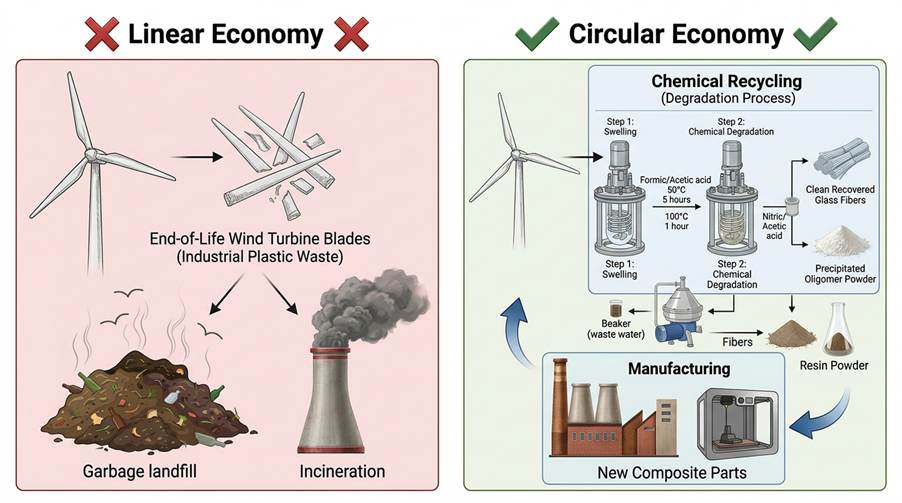
This is what holds hazards for the environment. A study of end-of-life options for composite waste indicates that landfills are cheapest in terms of carbon footprint per kg of waste but also consumes the material forever. Recycling, even though energy intensive, can reduce the demand to manufacture virgin fibers and resins, providing benefits over the whole life cycle (Witik, Teuscher, Michaud, Ludwig & Månson 2013). Figure 1 compares the end-of-life possibilities for composite waste.
But the question is: what exactly is epoxy resin?
In terms of material science, epoxy is called thermosets; a family of material that can’t be reversed once cured. It is not malleable like a plastic bottle and thus cannot be melted down and reformed. Nobody doubts the usefulness of a wind turbine blade, a boat hull, an aircraft part, a circuit board or sports item. Yet at the end of an epoxy composite product life, there is no easy way to recycle it using traditional methodologies. In 2023, the global production of epoxy resin was estimated at 3.9 million tons and is expected to rise by 6.75 percent annually to about 6 million tons by 2030 (Zhang, Shi, Qu, Shi & Tan 2025).
Many of us know that plastic bottles have a second life. Far fewer know that there is a complete category of industrial plastics which current recycling systems simply cannot digest. This research is working to bridge the gap.
What is tested in the Composite Circle project?
As part of the Composite Circle project, research at Centria has been underway to devise a chemical recycling method for composite materials as an approach to recover functional epoxy resin and good quality fibers from waste composite material. The method was developed based on information available in the literature and feasibility studies conducted at Centria within the Re-Comp project. It is designed for a common industrial epoxy system consisting of DGEBA resin cured with IPDA hardener and has been evaluated using multiple composite waste samples.
A test was performed with two scenarios:
– Pure epoxy casting plates were prepared as flat slabs of cured epoxy in two thicknesses, 2 mm and 6 mm. The plates were prepared using Diglycidyl Ether of Bisphenol A (DGEBA) epoxy resin system cured with Isophorone Diamine (IPDA) epoxy system, cured at room temperature, and subsequently post-cured at 80 °C.
– Glass fiber reinforced composite plates – using the same DGEBA/IPDA system.
How does the experimental setup work?
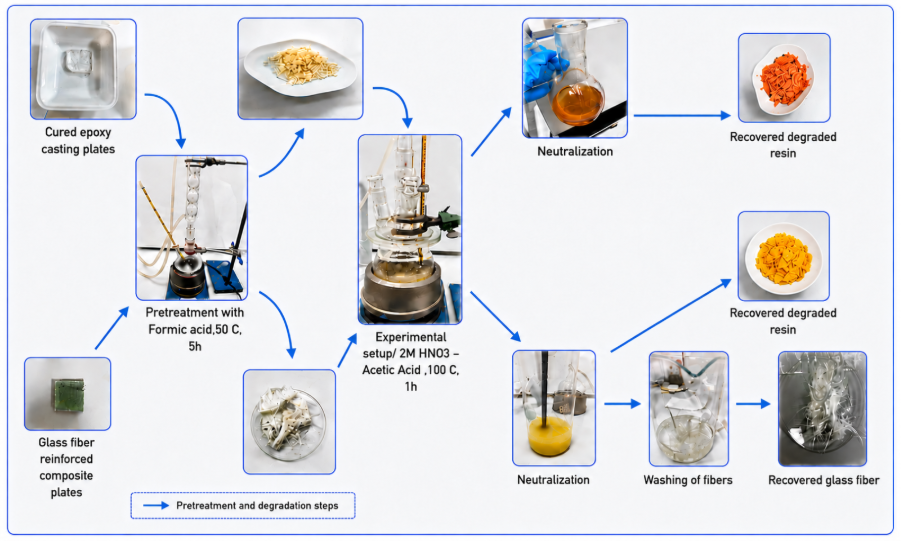
The recycling method involves two-step chemical processes. The first step involves pretreatment of the plates (cured castings, glass fiber composites) with formic or acetic acid, 50°C, 5h that is used to swell the polymer, allowing the principal chemicals to penetrate it more deeply.
The second step involves pre-treated material being put into a solution of 2M nitric acid and acetic acid. The solution acts as an oxidizing agent that will depolymerize/degrade the epoxy network. This is done at 100°C, 1h. The acid solution is neutralized after degradation, resulting in the precipitation of the degraded epoxy fragments (short polymer chains, oligomers) as a solid powder. These recovered oligomers can be incorporated into new epoxy formulations, and the mechanical properties and thermal stability of the material are comparable to those with fresh resin. The complete dissolution of the above-mentioned material was achieved. (Zhang, Shi, Qu, Shi & Tan 2025.)
What happened with pure epoxy?
Cured epoxy casting plates were fully dissolved in this setup. After neutralizing the solution, a solid oligomeric powder was successfully recovered. Consistent results are obtained in varying the thickness and size of the sample plates. The focus is to propose a setup that works well with samples of waste composite material. A process that is applicable to any sample geometry is more promising for real-world applications.
The recovered powder is for re-use in new products as a filler. This kind of recovered oligomeric material is used in composites having mechanical and thermal properties like or near to virgin material, which directly promotes the application of this method in the circular economy (Zhang, Shi, Qu, Shi & Tan 2025).
So, what happened to fiberglass composites?
The use of formic acid and acetic acid for the pre-treatment of the material promoted swelling which fascilitated liberation of the fibers from the network. Switching from formic to acetic acid not only provided milder conditions but also resulted in enhanced swelling in the pretreatment.
Under the mild conditions and action of mixed acids (2 M nitric acid, acetic acid) efficient degradation of the epoxy network was achieved. The process yielded clean and well separated glass fibers which will be further tested for their mechanical properties, while the degraded resin will be functionalized in subsequent experiments. Thermogravimetric analysis (TGA) of the recovered glass fibers under a nitrogen atmosphere revealed negligible mass loss throughout the heating program, confirming the efficient removal of the epoxy matrix and the absence of residual resin on the fiber surface. These results demonstrate the efficiency of the degradation process in recovering clean glass fibers suitable for reuse.
Sometimes, a small change in the step makes the whole process move more efficiently, and it is the most important discovery in laboratory research. Consequently, changing the source of the formic acid to acetic acid was a discovery of this type, which not only allowed us to shift to milder conditions but also could improve the yield of resin; the testing is still underway.
The manufacturing of glass fibers requires a lot of energy. The end-of-life value of the fibers remains if they can be recovered in a reusable form. The quality of recovered fibers and their suitability to use in new matrices are important criteria for determining the reusability of fibers, as highlighted before (Oliveux, Dandy & Leeke 2015).
Why does the recovery matter?
Overall, composites are utilized in transport, construction, and energy. At present, the general practice is to discard composites when they are done with their life span. The wind energy industry is facing a significant end-of-life challenge, as the blades are primarily made from fiber glass. The dire need for the hour is pushing the world toward recycling and finding the real solutions as 80 GW of European wind capacity is nearing the end of its life by 2030. The European wind industry has also committed a landfill ban on decommissioned turbine blades from January that is also pressurizing the world to devise a viable solution for circular economy. (Wind Europe 2025.)
Recent research activities revolving around composites is a part of an effort to change that practice; finding ways that are mild enough, practical enough, and scalable enough to be adopted by industry (Oliveux, Dandy & Leeke 2015). The findings from the chemical recycling of composite materials within the Composite Circle project at Centria contribute to advancing recycling opportunities for end-of-life wind turbine blades and other composite materials.
In a wider context, this is the type of applied research that Centria is ideally suited to perform: based on materials, conditions, and industrial needs.
Conclusions
In 2023, the global production of epoxy resin has been 3.9 million tons and is expected to grow to 6 million tons by 2030 (Zhang et al. 2025).
Europe’s wind capacity is nearing the end of its life: around 80 GW of wind capacity will reach its end of life in 2030, and by January 2026, a self-imposed ban on turbine blades that can be thrown into landfills will come into effect (Wind Europe 2025).
Chemical recycling offers a solution for recycling epoxy composite: The DGEBA/IPDA epoxy system was completely dissolved in about one hour at 100 °C.
Oligomeric powder recovered from waste can be used as a filler material in new epoxy products to produce epoxy powder with similar properties as virgin materials (Zhang, Shi, Qu, Shi & Tan 2025).
Optimized chemical treatment was successfully used to recover clean glass fibers from fiberglass composite plates.
What comes next?
This research provides a working proof of concept for the DGEBA/IPDA system for the conditions tested. The following steps will be directed towards:
– Assessing recovered oligomeric powder properties, trials to introduce functionality in it for better mechanical and thermal properties to validate its suitability as a filler in new formulations.
– Evaluation of the quality and reusability of the glass fibers recovered.
– Optimizing the process parameters (acid concentration, temperature, time) to increase efficiency.
– Real waste samples, more representative and eventually pilot scale testing.
The development of practical and industry-relevant recycling solutions for composite materials, as part of the Composite Circle project at Centria, is part of a broader initiative to achieve environmental sustainability and the goal of the circular economy in the field of materials.
This article is part of the Composite Circle project, funded by the Interreg Baltic Sea Region Programme and the European Regional Development Fund (ERDF). Centria coordinates the international project consortium.
References
Oliveux, G., Dandy, L. O. & Leeke, G. A. 2015. Current status of recycling of fibre reinforced polymers: Review of technologies, reuse and resulting properties. Progress in Materials Science, 72, pp. 61–99. Available at: https://doi.org/10.1016/j.pmatsci.2015.01.004. Accessed 20 May 2026.
WindEurope. 2025. Where do wind turbine blades go when they are decommissioned? Wind Europe. Available at: https://windeurope.org/news/where-do-wind-turbine-blades-go-when-they-are-decommissioned/. Accessed 20 May 2026.
Witik, R. A., Teuscher, R., Michaud, V., Ludwig, C. & Månson, J.-A. E. 2013. Carbon fibre reinforced composite waste: An environmental assessment of recycling, energy recovery and landfilling. Composites Part A: Applied Science and Manufacturing, 49, pp. 89–99. Available at: https://doi.org/10.1016/j.compositesa.2013.02.009. Accessed 20 May 2026.
Yang, Y., Boom, R., Irion, B., van Heerden, D.-J., Kuiper, P. & de Wit, H. 2012. Recycling of composite materials. Chemical Engineering and Processing: Process Intensification, 51, pp. 53–68. Available at: https://doi.org/10.1016/j.cep.2011.09.007. Accessed 20 May 2026.
Zhang, X., Shi, Y., Qu, C., Shi, X. & Tan, Q. 2025. Mild and Efficient Degradation of Amine-Cured Epoxy Resins Using Mixed Solvents. Journal of Applied Polymer Science, 142, e57311. Available at: https://doi.org/10.1002/app.57311. Accessed 20 May 2026.
Rubina Yasmine
RDI developer
Centria University of Applied Sciences
p. 050 320 7092
Rathish Rajan
RDI specialist
Centria University of Applied Sciences
p. 040 594 2702
Noora Korhonen
RDI specialist
Centria University of Applied Sciences
p. 050 569 6725