

Heidi Kaartinen-Liuska
https://urn.fi/urn:nbn:fi-fe20260914125631
Have you ever walked into a room with a bunch of devices – computers, sewing machines, laser cutters, and 3D printers – located maybe in a library, or some other public space? If you have, then you probably were in a makerspace, a communal creative place for (typically young) technology enthusiasts. What if this was taken a bit further, and it was possible to create functional prototypes with these makerspace devices? This article digs into the idea of transforming a university laboratory into an advanced makerspace.
Project AMPLE discusses the very idea of an advanced makerspace. The partners of the project have laboratories and other environments of different scales and sizes, used for projects – sometimes for case studies within the local enterprises, but they are typically not of nature of a public makerspace.
What is an advanced makerspace?
An advanced makerspace is a hands-on innovation environment where people design, prototype, and experiment possibilities using professional-grade tools and interdisciplinary knowledge. It’s not just a workshop, but an innovative space for problem-solving and making ideas tangible with tools such as rapid prototyping technologies (3D printers, CNC machines, laser cutters), electronics labs (soldering stations, microcontrollers, IoT kits), digital design software (CAD, simulation tools), a possibility for brainstorming and iteration, and a strong link to applied research.
The advanced makerspace enables learning by doing within cross-disciplinary collaboration. It lowers the barriers for experimentation and emphasizes iteration over perfection. Failure is also considered a valuable result within this environment and mindset.
What is the difference between laboratory and makerspace?
At first glance, an advanced makerspace and a university (of applied sciences, in case of Centria) lab can look quite similar: they both have equipment, projects, and people doing technical work. Their purpose, structure, and mindset are nevertheless quite different.
Purpose
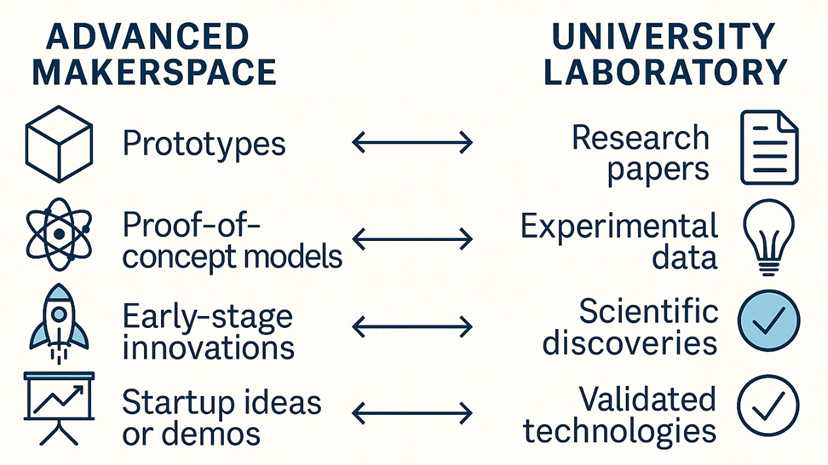
Advanced makerspace focuses on exploration and innovation and encourages trying new ideas, even if they fail. It is often driven by curiosity, prototyping, or entrepreneurial goals. University laboratory, on the other hand, focuses on scientific research and validation, works to test hypotheses and produce repeatable, reliable, and publishable results. It is typically tied to specific research projects or academic goals. (Fig. 1.)
Structure
Advanced makerspace is an open, flexible environment, and its users range from students to researchers to external partners. The projects can be self-directed or collaborative, and they have fewer protocols – keeping safety in mind, though. University laboratories are typically highly structured, and access is often restricted to specific people, courses or research groups. Laboratories have clear procedures, protocols, and supervision, and the work is often guided by a lecturer, a researcher, or academic framework.
Mindset
The iterative process is fast in a makerspace: build, test, adjust, and repeat. The developed prototypes do not need to be perfect right away, and failure is expected. Projects in a makerspace often combine hardware, software, user experience – and are therefore interdisciplinary by nature. Within the university laboratories, the experiments must be repeatable and controlled, and the failure is analyzed carefully and documented, being costly in terms of time, funding, or data integrity. Collaboration between disciplinaries happens, but often within defined research domains.
Why the distinction matters?
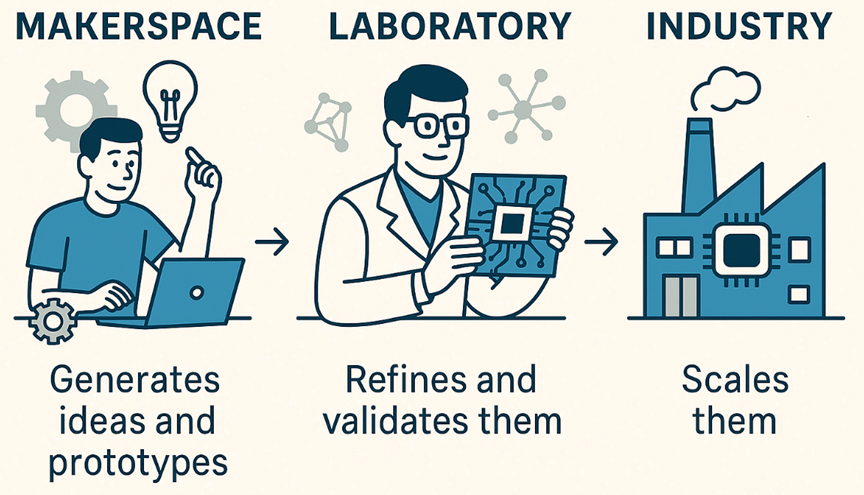
Understanding this difference is especially valuable in areas like technology transfer and technical coaching. Makerspaces are ideal for early-stage idea development and skill-building, and university labs are crucial for deep knowledge creation and validation. In a strong innovation ecosystem, these environments do not compete, but complement each other (Fig. 2):
1. Makerspace generates ideas and prototypes
2. Laboratory refines and validates them
3. Industry scales them
Changing the mindset
An advanced makerspace is not just a lighter version of a laboratory – it is a very different mindset wrapped in a technical environment. Where a lab seeks certainty, the makerspace embraces possibility. And it is often at the intersection of the two that the most impactful innovations emerge.
Turning a traditional laboratory into a makerspace is not about removing the rules, but rebalancing the environment from controlled experimentation toward creative, hands-on innovation. Think of it as shifting from “proving” to “exploring, while still respecting safety and expertise.”
Compared to a conventional makerspace, an advanced makerspace is not just about investing to more equipment, it is a shift in ambition:
– From learning tools to solving real problems
– From trying things out to developing usable outcomes.
And in strong innovation ecosystems, ideally all three exist – makerspaces to spark the ideas, advanced makerspaces to enable the functional prototypes, and laboratory environment and approach to verify them.
AMPLE –– Advanced Makerspaces for PiLot production by micro-Enterprises is a three-year-project, co-funded by the European Union from Interreg Northern Periphery and Arctic programme. On its second year, the project aims to creating case studies from needs defined by startups or micro companies.
Cover image of the article: Heidi Kaartinen-Liuska, 2026.
Heidi Kaartinen-Liuska
RDI specialist
project manager and communications officer, AMPLE project
Centria University of Applied Sciences
Tel. +358 40 729 9951