


Raffay Sultan
Erangi Jayasinghe
Rathish Rajan
https://urn.fi/urn:nbn:fi-fe20260831121533

What if discarded wood waste could be used to produce the next generation of sustainable materials? This research study explores how recovered wood waste can be reinforced into polymer composites, giving the material a new purpose while reducing reliance on virgin resources. In this way, an existing waste stream can be transformed into a valuable raw material and contribute to more practical and circular solutions.
”Waste is not simply something to discard, it can be a resource waiting for a new purpose.” This idea has become one of the guiding principles of the circular economy. Across the world, industries are rethinking how materials can be reused and repurposed, not only to reduce waste but also to recover value from resources that were once overlooked. One such resource is waste wood, which, despite reaching the end of its original service life, holds significant potential for developing sustainable composite materials.
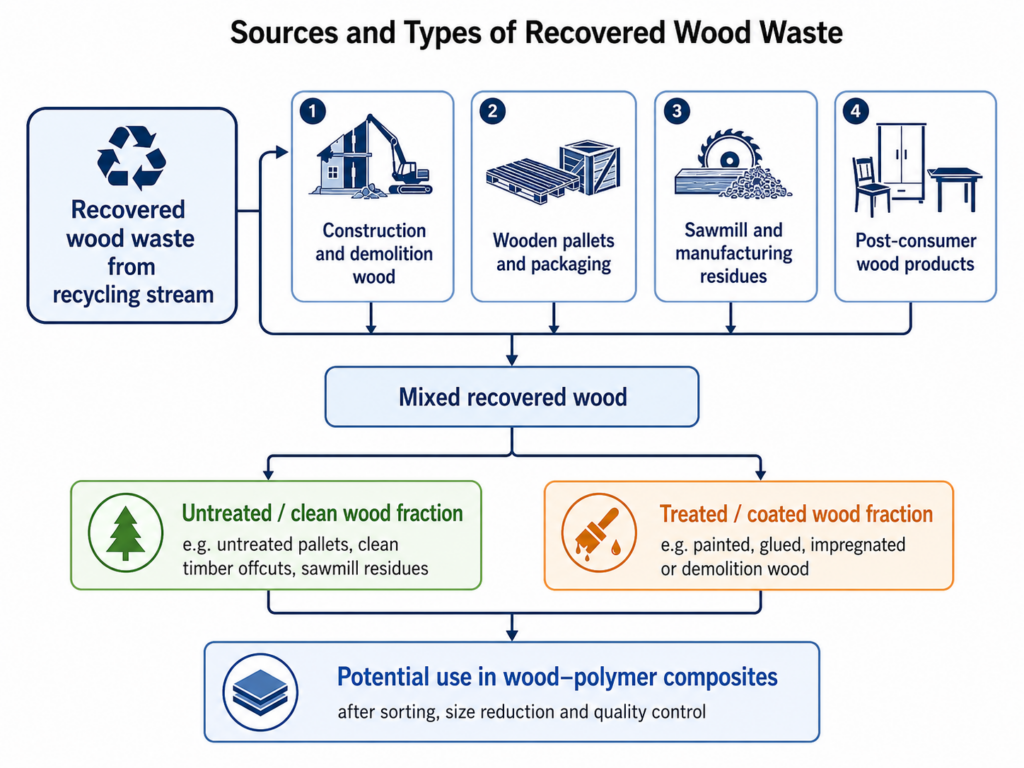
Every year millions of tons of waste wood are produced by sawmills, production sites, factories, and construction operations. Wood is one of the Finland’s most important renewable resources, as forests play a key role in both economy and daily life. However, even after wood has served its initial purpose, much of it is still considered low-value waste. While some waste wood is used to generate energy, large amounts remain unutilized. (Finnish Forest Industries 2026; Koskinen 2024.)
“What if this discarded waste wood could be used to create the next generation of sustainable materials?”
That question served as the foundation for utilizing waste wood by using it as a reinforcement in polymer composites as part of the BIO-2-PRINT research project funded by Interreg NPA (Interreg Northern Periphery and Arctic 2026) at Centria UAS. Rather than viewing end-of-life wood as waste, it can be regarded as a valuable resource for producing wood-polymer composites. This approach reduces the reliance on synthetic polymers while creating value from an underutilized waste stream and supporting circular economy principles.
Looking beyond recycling
Recycling is commonly connected with giving materials a second life. However, the contemporary circular economy concept goes a step further. Rather than just diverting waste from landfills, it considers how materials might continue to add value over several life cycles.
Even after a wooden pallet has reached the end of its service life, the wood still retains its valuable lignocellulosic structure. These elements have exceptional mechanical properties and can be used in whole new products. (Mitalova, Mital & Berladir 2024.) Instead of burning wood for electricity right away, these materials can be used to strengthen polymers and build composite materials for high-performance technical applications. Wood-polymer composites based on thermoplastic matrices can be mechanically recycled and reprocessed without significant impact on mechanical properties, although repeated processing may cause slight changes in properties such as colour and particle size. (Burgstaller & Renner 2023.) This strategy increases the useful life of wood while decreasing reliance on synthetic raw materials (Liikanen, Grönman, Deviatkin, Havukainen, Hyvärinen, Kärki, Varis, Soukka & Horttanainen 2019).
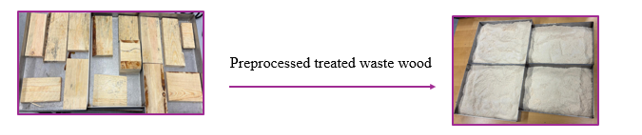
The waste wood utilized in this study was made up of type A /B waste wood which includes pre-consumer waste wood, packaging waste and commercial non-hazardous waste wood. Before being employed as a reinforcement material, waste wood was preprocessed by washing, drying, cutting, grinding, and sieving into 0.5 mm particle size as shown in Figure 2 to produce fine wood flour appropriate for composite manufacturing. These processing methods converted the waste wood into a consistent natural wood flour material suitable for composite manufacturing.
Reducing polymer content by utilizing nature
Polymer is one of the most versatile engineering materials accessible today. Its longevity, light weight design, and low manufacturing costs make it difficult to replace in a variety of applications. However, lowering the reliance on fossil fuel-based polymers has become a key sustainability goal. One realistic option is to replace some of the polymer content with renewable natural resources. (Abtew, Gebeyehu, Dejene & Atalie 2026.)
In this study, waste wood is replaced by 20 wt% of the polypropylene (PP) which is used to produce polymer composites. While PP continues to offer the continuous matrix required for structural performance, wood flour serves as natural reinforcement, boosting the material’s renewable component while decreasing the amount of synthetic polymer required.
If manufacturers replace even a small portion of traditional polymer with recycled natural fibres across thousands of tonnes of products, the reduction in synthetic polymer consumption is significant. This is one of the advantages of wood polymer composites. They show that sustainability does not always require completely replacing existing materials. Incremental improvements can sometimes lead to significant environmental and economic benefits.
One of the key challenges in developing wood-polymer composites is combining two materials with fundamentally different properties. The moisture absorption of wood arises from accessible hydroxyl and other polar groups in its components, particularly amorphous cellulose and hemicelluloses. However, moisture absorption is also strongly affected by cellulose crystallinity, polar groups in lignin, porosity, and cell-wall structure. In contrast, polypropylene (PP) is hydrophobic, meaning it repels water. This difference in surface chemistry results in poor interfacial bonding, which can limit the mechanical performance of the composite. In simple terms, wood flour readily absorbs water, whereas polypropylene (PP) repels it. As a result, the two materials do not naturally adhere to one another. Poor bonding reduces the stress transmission from the plastic matrix to the reinforcing fibres, lowering the composite’s mechanical strength. (Elamin, Li, Osman & Otitoju 2020; Genc & Ertas 2025.)
Compatibilizers are very useful in this situation. Compatibilizers are additives that facilitate the interaction of two incompatible materials. They reinforce the contact between wood fibres and the surrounding polymer allowing the composite to perform better under load. (Musa, Kumar, Rahim, Rasidi, Rennie, Rahman, Kanani & Azmi 2022.) Maleic Anhydride grafted Polypropylene (MAPP) is the most often used compatibilizer in wood polymer composites. It has been widely employed in industry due to its superior ability to promote fibre matrix adhesion. (Huang, Yang, Hung, Xu & Wu 2018.)
“Can nature offer an alternative for synthetic polymer-based compatibilizers? Can trees help us to solve a material science problem?”
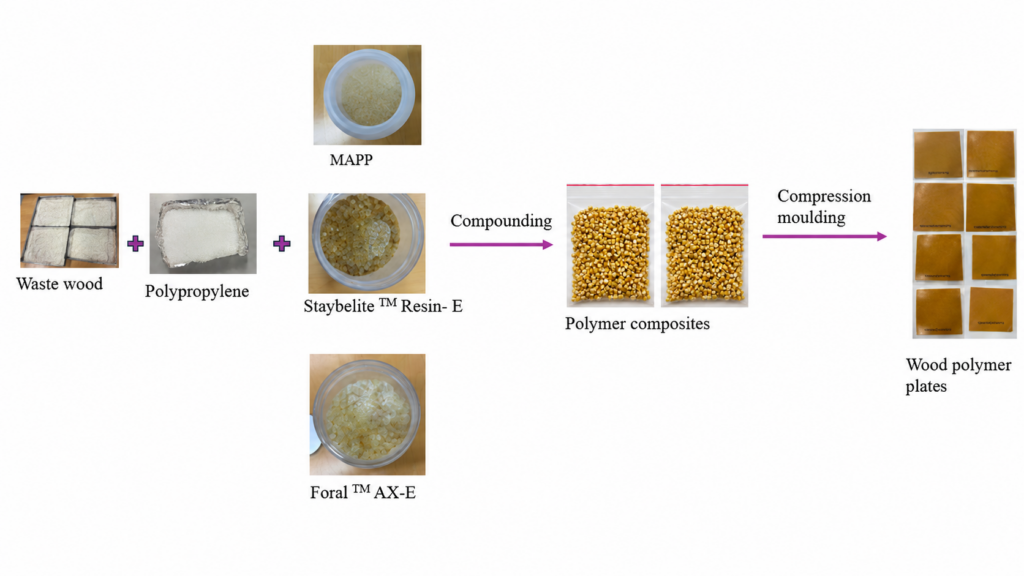
One of the most fascinating aspects of this study was determining whether bio-based compatibilizers generated from pine resin may serve a comparable function. Rosin is a natural chemical derived from pine trees that has been used for ages in a variety of products, including varnishes and adhesives. Because it is derived from renewable forest resources, it is a viable alternative to standard synthetic additives. (Genc & Ertas 2025.) Two hydrogenated rosins, Staybelite TM Resin- E and Foral TM AX-E, were studied alongside MAPP in this study.
Turning wood waste into wood polymer composites
Polypropylene (PP) was compounded with 20 wt% type A/B wood waste and three different compatibilizers at loadings of 1, 3, and 5 wt%. Heat and shear during compounding melted the polymer and ensured uniform dispersion of the wood particles, thereby enhancing interfacial bonding. The resulting composite melt is cooled and pelletized for better handling. Finally, the pellets are moulded into final products as shown in figure 3.
The properties of the produced composites were evaluated using Fourier Transform Infrared Spectroscopy (FTIR), tensile testing, and water absorption testing. These methodologies combined to provide insight into the chemical and physical interactions occurring within the composites, as well as their mechanical behavior and moisture resistance.
After testing, MAPP achieved the best mechanical performance demonstrating why it is still the industry standard. Nonetheless, rosin-based compatibilizers also improved interactions within the composite system, especially at appropriate concentrations. Although further research is needed before bio-based compatibilizers can completely replace conventional options, the findings indicate a significant possibility for generating greener composite compositions in the future.
Small modifications have a greater impact
What makes this study particularly significant is that existing resources were utilized more effectively. Wood waste now has a second life. Synthetic polymer consumption was reduced. Renewable forest derived additives were investigated as alternatives to traditional petroleum-based compounds.
Each improvement may seem minor on its own. Together they demonstrate how modest advances might help to achieve bigger environmental goals. This idea is at the core of the circular economy. Rather than depending on a single innovative solution, advancement is often achieved through a series of interrelated improvements that reduce environmental effect while retaining product performance.
Looking ahead
As companies seek more sustainable resources, recycled natural fibres are likely to become more essential. Finland’s robust forestry sector and well-developed recycling infrastructure offer significant chances to convert wood residues into high value engineered products rather than discarding them as garbage. This research offers little contribution to this larger transformation. It indicates that recycled waste wood is not a waste product, but rather a valuable natural resource capable of reinforcing polymer composites and lowering dependency on synthetic polymers.
It also emphasizes the existing potential provided by bio-based compatibilizers made from renewable forest resources. Perhaps the most essential lesson from this study is that sustainability starts with a simple shift in attitude. The pile of unwanted wood sitting outside a recycling centre may no longer represent the end of a product’s life. Instead, it may be the beginning of another.
This work was carried out as part of the BIO-2-PRINT project, funded by the Interreg Northern Periphery and Arctic Programme.
References
Abtew, A., Gebeyehu, K., Dejene, K., & Atalie, D. 2026. Recycled Cellulosic Natural Fibers and Their Reinforced Polymer Composites: Processing Methods, Applications, Challenges and Future Directions, Sustainability. 18(5). Available at: https://doi.org/10.3390/su18052500. Accessed 10 July 2026.
Alakangas, E., Koponen, K., Sokka, L. & Keränen, J. 2015. Classification of used wood to biomass fuel or solid recycled fuel and cascading use in Finland. In M. Savolainen (ed.), Bioenergy 2015: Book of Proceedings, 79–86. Jyväskylä: Benet Ltd. Available at: https://publications.vtt.fi/julkaisut/muut/2015/OA-Classification-of-used-wood.pdf. Accessed 30 July 2026.
Burgstaller, C. & Renner, K. 2023. Recycling of wood-plastic composites-A reprocessing study. Macromol, 3(4), 754–765. Available at: https://doi.org/10.3390/macromol3040043. Accessed 30 July 2026.
Elamin, M., Li, S., Osman, Z. & Otitoju, T. 2020. Preparation and characterization of wood-plastic composite by utilizing a hybrid compatibilizer system, Industrial Crops & Products, 154, 112659. Available at: https://doi.org/10.1016/j.indcrop.2020.112659. Accessed 10 July 2026.
Finnish Forest Industries. 2026. Forests and wood as raw material. Available at: https://metsateollisuus.fi/en/forests-and-wood-raw-material/. Accessed 10 July 2026.
Genc, M. & Ertas, M. 2025. From Wood Rosin to a Green Compatibilizer: Enhancing the Performance of Natural Fiber/Polypropylene Composites, Polymer Composites, 46(16), 15288-15300. Available at: http://doi.org/10.1002/pc.30129. Accessed 10 July 2026.
Huang, C., Yang, T., Hung, K., Xu, J. & Wu, J. 2018. The Effect of Maleated Polypropylene on the Non-Isothermal Crystallization Kinetics of Wood Fiber-Reinforced Polypropylene Composites, Polymers, 10(4), 382. Available at: https://doi.org/10.3390/polym10040382. Accessed 10 July 2026.
Interreg Northern Periphery and Arctic. 2026. BIO-2-PRINT: From waste to worth—Building a value chain for underutilized natural fibres as feedstock in 3D printing. Available: https://www.interreg-npa.eu/projects/bio-2-print/. Accessed 30 July 2026.
Jayasinghe, E. 2026. Effect of compatibilizers on the properties of treated wood waste reinforced polypropylene composites. Bachelor’s thesis. Centria University of Applied Sciences. Available: https://urn.fi/URN:NBN:fi:amk-2026052818771. Accessed 30 July 2026.
Koskinen S. 2024. Towards an economically viable use of recycled wood. Available at: https://puuinfo.fi/2024/06/18/towards-an-economically-viable-use-of-recycled-wood/?lang=en. Accessed 10 July 2026.
Liikanen, M., Grönman, K., Deviatkin, I., Havukainen, J., Hyvärinen, M., Kärki, T., Varis, J., Soukka, R. & Horttanainen, M. 2019. Construction and demolition waste as a raw material for wood polymer composites – Assessment of environmental impacts, Journal of Cleaner Production, 225, 716-727. Available at: https://doi.org/10.1016/j.jclepro.2019.03.348. Accessed 10 July 2026.
Mitalova, Z., Mital, D. & Berladir, K. 2024. A Concise Review of the Components and Properties of Wood–Plastic Composites, Polymers, 16(11), 1556. Available at: http://doi.org/10.3390/polym16111556. Accessed 10 July 2026.
Musa, L., Kumar, N., Rahim, S., Rasidi, M., Rennie, A., Rahman, R., Kanani, A. & Azmi, A. 2022. A review on the potential of polylactic acid based thermoplastic elastomer as filament material for fused deposition modelling, Journal of Materials Research and Technology, 20, 2841-2858. Available at: https://doi.org/10.1016/j.jmrt.2022.08.057. Accessed 10 July 2026.
Raffay Sultan
RDI expert
Centria University of Applied Sciences
p. 050 566 2787
Erangi Jayasinghe
RDI student assistant
Centria University of Applied Sciences
p. 050 336 4931
Rathish Rajan
RDI expert
Centria University of Applied Sciences
p. 040 594 2702