

Egidija Rainosalo
The CompositeCircle project aims to connect industry, business actors, existing recycling infrastructure, and technical knowledge in order to create a functioning recycling ecosystem for fibre reinforced polymer composites across the Baltic Sea countries.
One of the largest future waste streams of those materials in Nothern Europe is wind blades. As wind energy continues to expand in northern countries, the need for circular solutions for wind turbine blades becomes increasingly urgent.
The wind turbines in Baltic region are supplied by several major European manufacturers, including Vestas, Nordex, Siemens Gamesa, LM Wind Power, and Enercon. These manufacturers are therefore important stakeholders for understanding the composition of existing wind turbine blades and anticipating future end-of-life material streams.
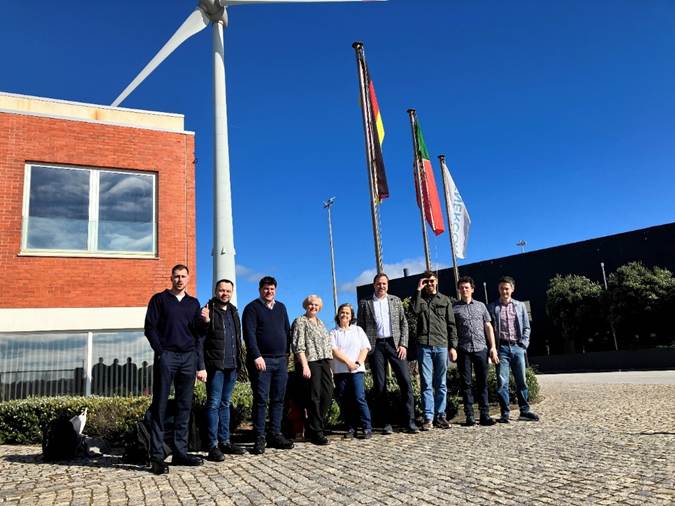
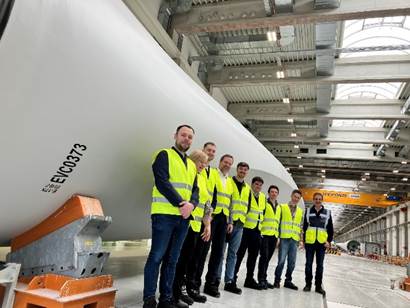
Representatives of CompositeCircle project initiated discussion with German wind turbine manufacturer Enercon Ltd and in spring 2026 visited company’s blade manufacturing site in Portugal, Viana do Costelo.
The main goal of the visit was to gain a deeper understanding of wind turbine blade materials, manufacturing technologies, and sustainability improvement strategies, while also obtaining first-hand insights into the role and activities of blade manufacturers in developing recycling value chains for wind turbine blades.
Design and materials of wind turbine blades from recycling perspective
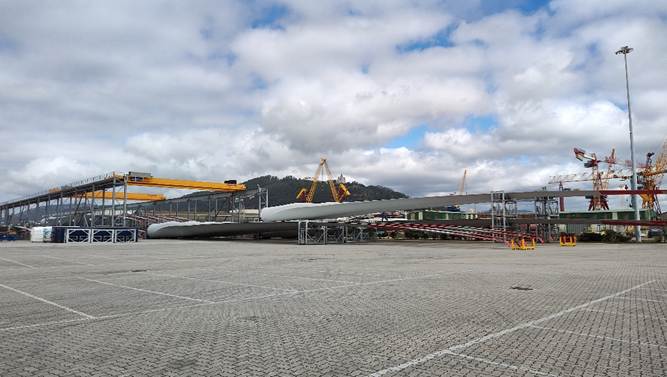
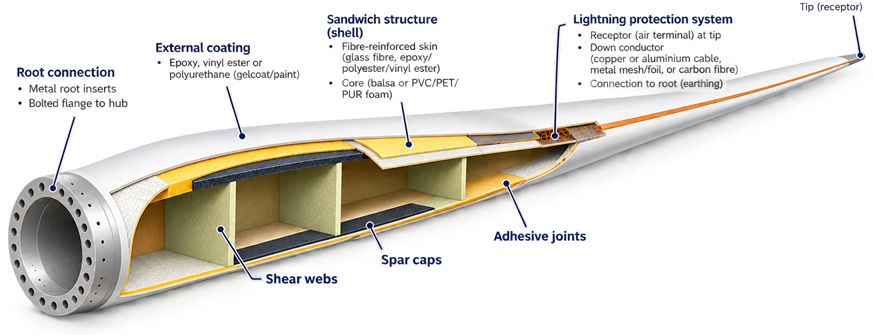
Wind turbine blades are complex composite sandwich structures, typically consisting of fibre-reinforced polymer shells, internal load-bearing spar caps and shear webs, core materials such as balsa or synthetic foam, adhesive joints, protective coatings, root inserts, and integrated lightning protection systems. Example design of wind blade presented in Picture 3 and composition of 4 different blades in Table 1.
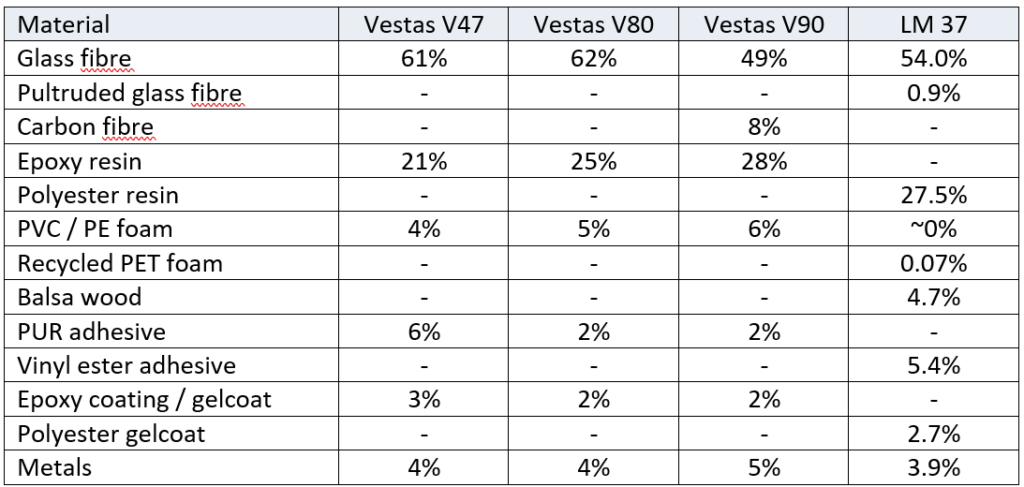
Notes: “-” means not listed in the passport, not necessarily absent. Values are rounded and may not sum to 100%. The LM 37 figures are calculated from reported masses.
Wind turbine blades are predominantly manufactured from glass-fibre-reinforced polymer composites, using epoxy resin matrices, polyester, and vinyl ester resins. Epoxy resins are reported as the most commonly used polymer matrices in modern wind turbine blades, due to their favourable mechanical properties, fatigue resistance, and adhesion to reinforcing fibres (Mishnaevsky Branner, Petersen, Beauson, McGugan & Sørensen 2017). However, polyester and vinyl ester resins are also used, and resin selection varies between manufacturers and blade models.
Carbon-fibre reinforcement is incorporated into certain blade designs, particularly larger blades (e.g. Vestas V90), where higher stiffness and lower structural weight are required. Carbon fibre can also contribute to lightning protection because of its electrical conductivity. This eliminates the need for separate metallic meshes or conductors, such as copper.
From a recycling perspective, carbon fibre integrated into the composite structure may, depending on the selected recycling route, be processed together with glass-fibre composite as for example in co-processing in cement kiln. Old blades though contain metal mesh or rods along the whole length of the blade, which in most cases need to be removed.
Balsa wood as well as other synthetic foams, such as PVC, polyurethane, and polyester, are used as core materials. The presence of PVC foam core materials in end-of-life wind turbine blades presents additional challenges for recycling. Due to its chlorine content, PVC can complicate thermal, such as co-processing in clinker production and chemical recycling processes by increasing the risk of corrosion, emissions and contamination of recovered materials. Presence of higher PVC content may require additional separation and treatment steps.
Surface coatings of blades are epoxy, vinyl ester, or polyurethane-based materials. They are not hindering co-processing, however in chemical recycling they might have a negative influence.
The largest concentration of metal in the blade is usually at its root, where the blade is connected to the hub. Bolts are used for fastening to the hub, which allows easier detachment. Bolts might also be reused for same or other applications or recycled as material.
Given the considerable variation in material composition between wind turbine blade manufacturers and models, Digital Product Passports are crucial for identifying material constituents, assessing their recyclability and selecting the most suitable recycling routes for end-of-life blades. This information is highly valuable for recyclers, as it can also support more accurate planning of dismantling, cutting, and pre-treatment.
Enercon’s Approach to Sustainability and End-of-Life Blade Recyclability
The company aims to develop recyclable blades by 2030, reflecting the wider industry shift towards waste avoidance and improved circularity. Recyclability, however, depends strongly on the availability and suitability of external recycling routes and well-developed recycling value chains. Therefore, blade design alone is not sufficient; it must be connected to realistic end-of-life infrastructure and accepted recycling methods.
The company is committed to WindEurope’s initiative to stop landfilling decommissioned wind turbine blades by 2025 and aims to apply this principle not only in Europe, but also globally. In this context, straightforward energy recovery by incineration is not considered an acceptable recycling solution, whereas co-processing in cement production may be accepted because it enables both energy recovery and material substitution.
As a proactive step towards future regulatory compliance and as an important enabler of circular end-of-life value chains, the company is developing Digital Product Passports for new blades. These passports are intended to describe the main material types used in each blade, their approximate quantities, and their distribution within the blade structure.
The company noted that they are also open for sharing material composition and recycling-relevant information for older blades upon request, subject to a non-disclosure agreement. This approach enables recyclers and value-chain partners to access the information needed for end-of-life planning and implementing while protecting confidential design and manufacturing knowledge.
In addition to developing new recyclable blade concepts, the company focuses on repair over blade exchange whenever technically and economically feasible. This includes not only on-site repair, but also the possibility of returning blades to the factory for repairs, refurbishment, or use as a spare blade. Also, secondhand market for used turbines is considered.
According to the company’s policy, its responsibility and influence over blade end-of-life management are closely linked to the project ownership and service model. In projects covered by full-service agreements, the company can take a more active role in supporting maintenance, repair decisions, and end-of-life planning. In cases where the turbines are owned and operated by other actors and waste responsibility remains outside the company’s service scope, its ability to influence the final treatment route is more limited. Therefore, the company’s approach highlights the need to establish reliable recycling value chains in the countries where it operates, so that responsible blade end-of-life solutions can be implemented.
From Visit Outcomes to Circular Value Chain Development
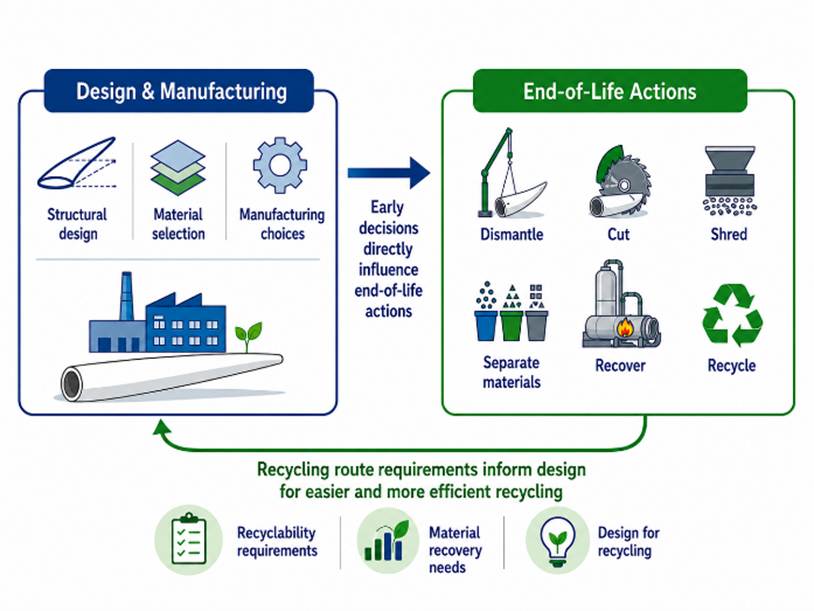
The visit and gathered knowledge from other sources show that it is clear that wind blade recycling cannot be solved only at the end-of-life stage. Decisions made during design and manufacturing directly influence how blades can later be dismantled, cut, inserted components and materials separated, shredded, recovered, or recycled. Blade manufacturers, however, need also a clear understanding of the requirements for potential recycling routes and existing supply chains, as this knowledge can guide structural design, material selection, and manufacturing choices toward blades that are easier and more efficient to recycle (Picture 5).
The next step is to translate these insights into practical value-chain actions. CompositeCircle will work to map available recycling infrastructure, connect dismantling, cutting, transport, shredding, and recycling actors, and involve wind turbine and blade producers in knowledge exchange. Cooperation with additional manufacturers will be important to better understand different blade designs, material compositions, and information needs for recycling.
Based on these activities, the project aims to develop a framework agreement for circular value chains that integrate wind turbine owners, blade manufacturers, service providers, recyclers, and end-users of recycled materials. This framework should define roles, information-sharing principles, technical requirements, and cooperation models needed to move from individual discussions towards functioning recycling value chains for wind turbine blades in the Baltic Sea Region.
Acknowledgement: The visit and this article are part of the CompositeCircle project, co-funded by the European Union through the Interreg Baltic Sea Region Programme. The project supports the development of circular value chains for composite materials, with a particular focus on wind turbine blades and other composite waste streams in the Baltic Sea Region.
Special thanks to Mindaugas Urbonas from Enercon for organising the visit, and to Maria Lentinen, Hugo Meira, and Vera Costa for sharing valuable insights into the company’s operations. I would also like to thank my fellow travellers, Roman Bykov (LEA), Michail Beliatis (Aarhus University), Andrejs Morozovs (JSC “BAO”), Linas Sabaliauskas (LVEA), Edgaras Maladauskas (LVEA), and Emilis Mišinas (ENERCON), for making this a memorable and insightful experience.
This article was prepared with the valuable contributions and support of all participants during the visit.
In preparing the article, generative AI (ChatGPT) was used for copyediting, grammar checks, and readability refinement. The content, literature analysis, and interpretation were developed by the author.
References
CompositeCircle project. https://interreg-baltic.eu/project/compositecircle/.
LM 37. 3Blade material passport. Availabe at: https://www.lmwindpower.com/sites/default/files/2025-06/TR-18004_A1-Blade-Material-Passport-LM-37.3-P2.pdf?utm_source=chatgpt.com . Accessed 28.10.2026.
Mishnaevsky, L. Jr., Branner, K., Petersen, H. N., Beauson, J., McGugan, M., & Sørensen, B. F. 2017. Materials for Wind Turbine Blades: An Overview. Materials, 10(11), 1285. Available at:
https://doi.org/10.3390/ma10111285.
Renewables Information. 2023. Wind blade manufacturing – A quick know-how. 2.6.2023. Available at: https://renewables-info.com/2023/06/02/wind-blade-manufactoring-a-quick-know-how/. Accessed 27.5.2026.
Vestas V47. Material passport V47. Available at: https://www.vestas.com/content/dam/vestas-com/global/en/sustainability/environment/Blades-V47_Material_Passport.pdf.coredownload.pdf. Accessed 28.10.2026.
Vestas V80. Material passport V80. Available at: https://www.vestas.com/content/dam/vestas-com/global/en/sustainability/environment/zero-waste/Blades-V80_Material_Passport.pdf.coredownload.pdf. Accessed 28.10.2026.
Vestas V90. Material passport V90. Available at: https://www.vestas.com/content/dam/vestas-com/global/en/sustainability/environment/zero-waste/Blades-V90_Material_Passport.pdf.coredownload.pdf. Accessed 28.10.2026.
Egidija Rainosalo
RDI coordinator
Centria University of Applied Sciences
p. 044 725 0264