
Mira Valkjärvi
https://urn.fi/urn:nbn:fi-fe20260914125630
2.700 liters of water.
One person drinks that amount in 2.5 years (European Parliament 2024) if they have appropriate access to water.
The average American uses about 300 liters of water a day (EPA 2025) and a Finn around 140 liter a day (Motiva 2025).
That is how much water it takes to make one cotton T-shirt. Yes, that shirt you are wearing!
The GENGREEN project’s living lab called Kokeilupaja hosted the very first environmental initiative in Pietarsaari on April 16, 2025. During this initiative, students of the Centria Pietarsaari campus got immersed in the life cycle of a T-shirt. The aim of the initiative was to raise awareness of the many issues related to the textile industry, ranging from environmental issues to social sustainability questions.
As someone who has dedicated themselves to sustainability and understanding the big transitions needed, I often find myself pondering how we can spark excitement and action in people. While I have both taught higher education students and held trainings for companies, I have noted a few similarities in how to approach the topic. Those that take part in voluntary sustainability education are already interested in the topic and just need support, appropriate tools, justifications, and a whole lot of community support. These individuals are not the ones we need to worry about. Students taking courses, either by force or desire, are generally more open to new topics and learning if the teaching setting is appropriate. A typical lecturing situation, while at times effective, is also heavily influenced by the skills of the lecturer and whether they can spark interest with this traditional tool or not. Methods in which participation is highlighted tend to perhaps alleviate these issues by relying solely on the lecturer’s abilities. Of course, then the ability to transfer large quantities of knowledge is harder, just as in the case of sustainability. So perhaps the questions we are left with are: how do we get those who are not interested in sustainability to participate in sustainability training, and what should the training be like?
Based on my observation, a great deal of teaching and knowledge these days is online and often in a self-study type of setting. While I find it great in principle that we have access to information and the ability to further ourselves, I would still steer away from these models. People need connections, especially at an age when they can ask AI anything and get some kind of results. By far, the most impactful moments in getting people excited about sustainability have been those where people are together, be it an online or hybrid lecture or an in-person workshop. Especially with sustainability, people often feel it to be too big, complex, and filled with political agenda. This is why we wanted to attempt a more practically oriented approach to sparking interest in sustainability, specifically, by tackling an issue that is close to every human being. Thus, we present to you the life of a T-shirt workshop.
Setting the scene
To get students into the right frame of mind and open to experience, we set up the workshop as 10 different pitstops with information about the life cycle of a T-shirt, along with a set up stage before they begin. The first step, as participants got to know the path they would travel during the workshop, was to design their own T-shirt on a large piece of paper. After this, they walked along a predesigned path through 10 stops. At each stop, they would first encounter a question, and they would first as a group attempt to answer the question to their drawn T-shirt. Then, they would flip the paper around to reveal more information about the topic along with useful tips to deepen their discussion. Some stops also included additional material, either infographics or pictures, to highlight key issues. The stops were:
1. What material is your T-shirt made of? Check the labels of your own clothing.
2. Draw the production chain of a T-shirt.
3. What color is your T-shirt?
4. Which country is your shirt made in? (Again, check your own labels.)
5. How many countries do you think your t-shirt has been to before you? What about after you?
6. What influences your decisions about buying clothing?
7. How can I extend the life cycle of my clothing? How can I keep them in use longer?
8. What happens to my clothes after me?
9. Can I donate my clothing?
10. What does the future of clothing look like?
Outlining sustainability during the stops
The purpose of each stop is to highlight the many issues of the textile industry, not only of the fast fashion but of the entire value chain. We start off with a quite simple question of what material a T-shirt is made of. Participants are encouraged to take a better look at the labels we have on our clothing, and what information they provide. The purpose of discussing materials used in clothing is to highlight that each material has its strengths and weaknesses. Cotton was highlighted in this step, as most T-shirts are made of cotton, and it is a natural fiber. Cotton is a textile that grows in specific climates, requires large amounts of water, and is vulnerable to pests and disease. Cotton was compared to another natural fiber, such as linen. Linen as a material is not as particular about its growing conditions and is more resilient than cotton. Yet despite this, the material has its own environmental impact, as its production requires soaking the material. Participants also discussed materials like polyester and viscose, which led to discussion about the usage of fossil fuels, and the issues of microplastics from textiles in water (Suomen Tekstiili ja Muoti 2022a).
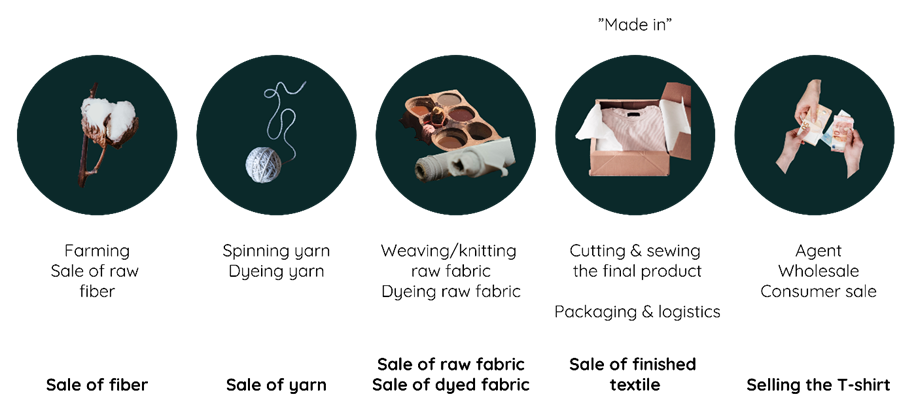
The next step for participants was to consider the value chain of the T-shirt, and at later stops, where the shirt is “made in” and how far the T-shirt travels. These questions aim to highlight the long-distance materials, fibers, textiles, and products travel before they reach their intended user. The purpose is also to understand how, for example, cotton becomes a shirt, and the many people and companies involved. This highlights many issues in the modern-day value chains, from labor intensive processes to forced labor, and the lack of information consumers have about their products. Often, the “made in” label only discloses where the textile material was sewn into a T-shirt – not where the material is from, where it was dyed, or any other steps before assembly.
As we progressed along the value chain of a T-shirt, we next arrived at the question about color: how materials and textiles are dyed. Here, the focus was especially on the environmental impact of dyeing processes, which were highlighted with images of polluted or colored rivers – waters that local communities are often forced to live alongside and rely on. Many of the participants are originally from areas where the production of a T-shirt is far more of an everyday event. Yet many of them still realized new aspects of these matters that they had not considered. The realizations were especially related to the huge amount of travel a single T-shirt may make. Yet, during this step we also discussed more positive views on dyeing, ranging from traditional methods of dyeing that are less harmful for nature to the different types of dyes, and also innovations in dyes. This section also highlights concerns about chemicals used as finishing agents, noting that in some cases, these substances can pose serious risks to human health. Many cases have been highlighted about fast fashion, including harmful chemicals (Pinto & Peleg Mizrachi 2025), and within the EU, the issues of some fast fashion companies avoiding EU legislation by delivering directly to consumers that are unaware of the dangers this poses.
As we come to the point where the T-shirt finds its way to consumers, we asked participants to consider why do they consume. What issues impact their decision to purchase clothing, and what is the rationale behind it. Here we gave participants a look into the price of a T-shirt and how it’s distributed between the many parties in the process. In this step, participants are quite often surprised by how little the actual manufacturing process earns, while the brand and whole seller are the ones keeping most of the money. From this figure you can understand where the money flows:
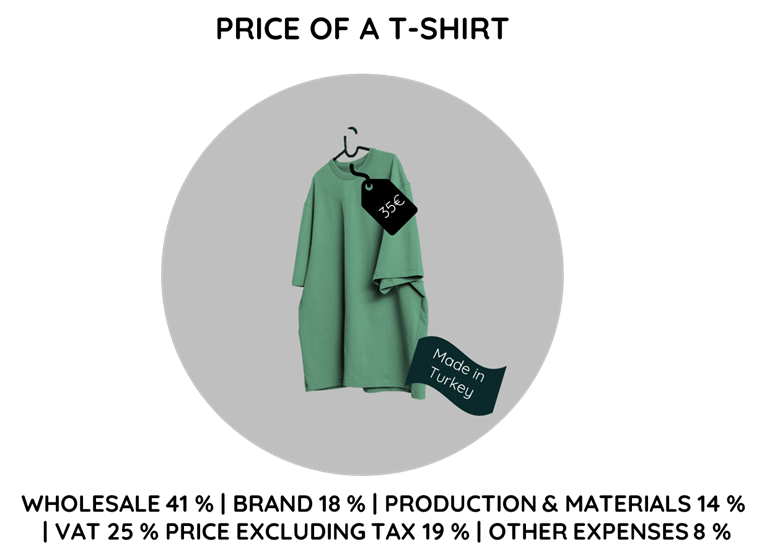
The latter part of the workshop focuses on what happens to the clothing while we own it and after we decide we do not need it anymore. This section aims to highlight the issues of fast fashion and overconsumption. Discussing also issues of losing traditional skills of being able to mend clothing, replacing defective parts and refreshing clothing. One might even say that modern generations may not even desire these skills or see traditional textile related skills as old-fashioned. This step also included trends in underconsumption and normalizing how clothing looks and should look. Specifically, the participants were reminded that it is normal for clothing to look worn, and that you are not supposed to acquire new clothing weekly or even per season. Yet the purpose here is not to discourage people from being interested in fashion and having style but rather to make people understand that the current economic model only cares about constantly selling us something we do not need, and which is of poor quality. This is why it is important to bring up the circular economy of the textile industry.
The textile industry needs more sustainable solutions, starting from how we design new products to how we deal with those already on the market. It is said that we have already produced enough clothing for the next three generations to come. The gigantic textile waste piles are visible from space (Loh 2023), highlighting also that in some cases, alleged recycling campaigns of clothing are just greenwashing. The fashion industry is filled with examples of greenwashing, from advertising repair services while at the same time destroying sellable goods, to offering bigger sizes only online and then charging for returns when customers cannot find an appropriate size due to a lack of sizing charts. We also highlight the issues of how to appropriately dispose of unwanted clothing, noting here that the best solution for anyone is to find an appropriate home for the clothing rather than donating it to become some other organizations’ problem aka waste.
Is there any hope for the future?
While the workshop aimed to give participants much to reflect on and to understand the varying aspects of a T-shirt life cycle, we did not wish to leave them with a feeling of impending doom but rather with a hopeful spirit. At the last stop, we asked participants to imagine what the future of clothing could look like. These ideas included lending clothing, long-term clothing rentals, new technology for material recycling, clothing libraries, among others.
Participants left the event with a sense of excitement, many saying that they learnt more about something they thought they understood and used every day. The principle of how a T-shirt is made is familiar to many, but without the experience they would never have questioned whether things could be done differently. As organizers, our hopes were that participants would leave with the thought that doing things differently in a sustainable way is in fact an opportunity rather than a threat. As such, we encourage you, the reader, to also take action. A more sustainable fashion and textile industry is done together and by sharing knowledge. So, we leave you with this tip:
The best item of clothing you can acquire is already in your closet, but if you do need something new remember this order: borrow from family and friends, utilize services, buy locally second hand, buy from local small sustainable companies, buy from local online second hand platforms, buy from local big sustainable companies, and avoid ultra-fast fashion with all costs. If you are in the EU, always buy within it and do not be tempted by the overconsumption of influencers – that is not normal and it’s their job to make you consume.
The GENGREEN project is funded by Interreg Aurora. Learn more about the project here: https://net.centria.fi/en/project/gengreen/.
References
Aronen, J. 2019. Puuvillan tuotanto kurittaa ympäristöä – halvan paidan todellinen hinta ei näy kuluttajalle. Reilu kauppa ry. Available at: https://reilukauppa.fi/artikkelit/puuvillan-tuotanto-kurittaa-ymparistoa-halvan-paidan-todellinen-hinta-ei-nay-kuluttajalle/. Accessed 8.9.2025.
European Parliament. 2024. The impact of textile production and waste on the environment (infographics). Available at: https://www.europarl.europa.eu/topics/en/article/20201208STO93327/the-impact-of-textile-production-and-waste-on-the-environment-infographics#:~:text=It%20takes%20a%20lot%20of,drinking%20needs%20for%202.5%20years. Accessed 8.9.2025.
Loh, M. 2023. Fast fashion has spawned a mountain of leftover clothes in the Chilean desert that’s so massive it can now be seen clearly from space. Business Insider. Available at: https://www.businessinsider.com/fast-fashions-mountain-leftover-clothes-chile-desert-seen-from-space-2023-5. Accessed 8.9.2025.
Motiva. 2025. Vedenkulutus. Available at: https://www.motiva.fi/koti_ja_asuminen/energiatehokas_arki/vedenkulutus. Accessed 8.9.2025.
Pinto, V.C.D., Peleg Mizrachi, M. 2025. The Health Impact of Fast Fashion: Exploring Toxic Chemicals in Clothing and Textiles. Encyclopedia, 5(2), p.84.
Suomen Tekstiili ja Muoti. 2022a. Tekstiiliopas. https://www.stjm.fi/palvelut-ja-tietoa-yrityksille/materiaalit-kemikaalit-ja-standardit/tekstiilimateriaalit/. Accessed 8.9.2025.
Suomen Tekstiili ja Muoti. 2022b. Mistä vaatteen hinta muodostuu? https://www.stjm.fi/tekstiili-ja-muotiala-suomessa/tiesitko-taman-tekstiili-ja-muotialasta/mista-vaatteen-hinta-muodostuu/. Accessed 8.9.2025.
United States Environmental Protection Agency. 2025. Statistics and Facts. Available at: https://www.epa.gov/watersense/statistics-and-facts. Accessed 8.9.2025.
Mira Valkjärvi
RDI specialist
Centria University of Applied Sciences
p. 050 571 2082